

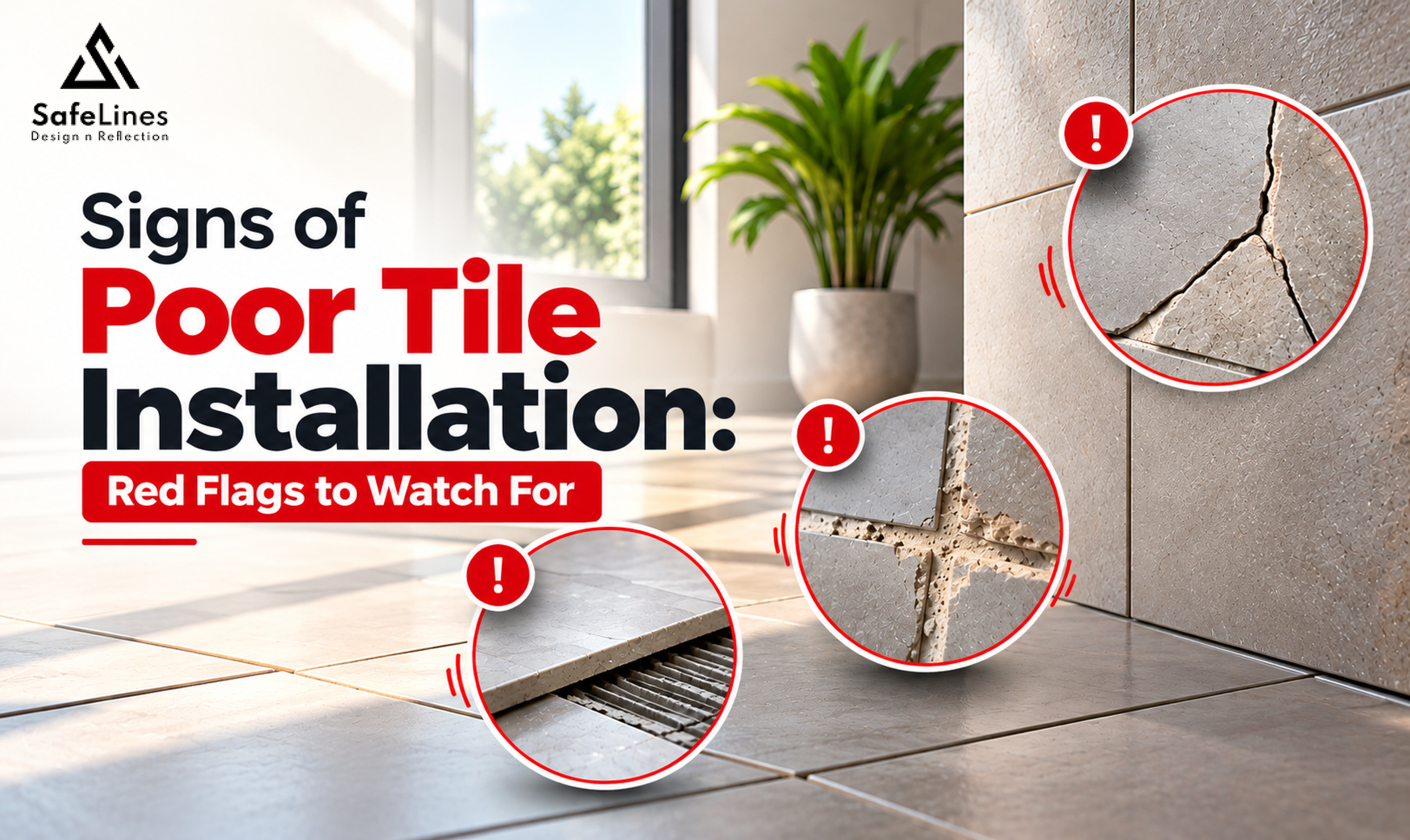
A tiled floor may look perfect when the installation is complete and still hide problems that may start to show up months later. The visible signs of poor tile installation are not dramatic at first. As foot traffic starts and the floor goes into regular use, early warnings such as a slightly uneven floor, a hollow sound underfoot or recurring grout cracks can indicate that the tile was installed without the preparation and precision it requires.
Although these issues may seem minor at first, they can gradually affect the floor’s overall look, strength, and everyday use. In some cases, loose tiles, water seepage or damaged grout may lead to costlier repairs.
Knowing what to look for when inspecting the new floor installation can give homeowners enough time to act and address issues while repair options are still manageable. Through this guide, we will help you understand the potential red flags that are clear signs of poor tile installation.
Common Signs of Poor Tile Installation You Should Never Ignore
Some tile installation problems are easy to spot, while others become noticeable only after the floor has been used for a few weeks or months. The following signs can help you identify areas that need attention.
Uneven Tiles and Lippage
Walk across a tiled floor and look at it from a low angle. If the edges of neighbouring tiles do not sit at the same height, that is a sign of an uneven surface. This difference in height is called tile lippage.
Small variations can occur depending on the tile’s shape, size, and surface characteristics. However, noticeable height differences may indicate problems with floor preparation, adhesive coverage, or the way the tiles were positioned during installation.
Hollow Sounds When Tapping Tiles
The second possible sign of poor tile installation is when a tile sounds hollow when tapped lightly, especially when compared with nearby tiles. Homeowners sometimes notice this while walking across the room or moving furniture.
One possible reason is incomplete contact between the tile and the adhesive beneath it. Gaps under a tile can affect how sound travels through the floor. However, the tile material, the underlying surface, and installation conditions can also influence the sound.
There is no need to strike the floor tiles hard or use tools to test them. Light tapping is enough to notice a difference. If you suspect a problem, let a qualified tile installer assess the area before deciding whether a repair is necessary.
Uneven Grout Lines and Misaligned Tiles
Look at the grout joints running between the tiles. They should generally follow a consistent pattern, with spacing that suits the selected tile and the planned layout.
If some joints are noticeably wider than others, the lines appear crooked, or the tile pattern drifts across the room, the installation may have lacked careful planning. These issues are often easier to notice in rooms with large tiles or a clear grid pattern.
A slight difference in spacing may be mainly cosmetic. But more pronounced misalignment can make the overall finish look poor and may complicate work around doorways, corners, and fixtures.
Cracked, Chipped, or Loose Tiles
Cracks across a tile, chipped corners, lifted edges, and tiles that move when stepped on are all signs that need immediate attention. These problems can appear shortly after installation or develop later during regular use.
This could be due to different reasons. For instance, a tile may have been damaged during handling or cutting, or it may lack sufficient support underneath. A heavy impact, movement in the underlying floor, or another issue can also lead to damage.
A cracked tile in an otherwise stable floor may need only a localized repair. A tile that moves underfoot is a different concern because continued movement can affect the surrounding joints and neighbouring tiles. Avoid repeatedly stepping on a loose tile to check whether it moves.
Crumbling or Cracked Grout
Grout fills the joints between tiles and gives the floor a finished appearance. When it starts crumbling, develops repeated cracks, or disappears from sections of a joint, the problem should be addressed immediately.
Damaged grout may result from poor application, unsuitable materials, movement beneath the tiles, or other conditions affecting the floor. If the same joint cracks again soon after repair, simply filling it once more may not solve the underlying issue.
It is also useful to understand the difference between grout and tile adhesive. Grout fills the visible gaps between tiles, while adhesive holds the tiles to the prepared surface beneath them. Repairing grout does not necessarily correct a problem with the adhesive or the support below the tile.
Water Pooling or Incorrect Floor Slope
In a bathroom, shower area, or utility space, water should move towards the intended drainage point. If it repeatedly collects in a particular spot, the floor may have an unsuitable slope or another drainage-related issue.
The required slope depends on the room’s purpose and drainage arrangement. For example, a shower floor has different drainage needs from a dry living room. Poor planning or inaccurate floor preparation during installation may contribute to water collecting where it should not.
Observe where the water collects and whether it drains as expected during normal use. If the problem continues, ask a flooring professional to assess the slope and surrounding conditions.
Water Seepage and Damp Patches
Persistent dampness near floor edges, recurring moisture marks, or damp patches on an adjoining wall can indicate a moisture problem. These signs are particularly relevant around bathrooms, kitchens, and utility areas.
Damaged grout may not be the only possible cause. Failed waterproofing, leaking plumbing, or moisture coming from another part of the building can produce similar symptoms.
Notice where the damp patch forms, whether it returns after cleaning, and whether it becomes worse after water is used nearby. Share these observations with a skilled professional.
Poor Tile Cuts and Untidy Edges
Look closely at the areas around door frames, pipes, corners, and fixed fixtures. Poorly cut tiles may have rough edges, awkward gaps, or unfinished sections that stand out against the rest of the floor.
Accurate measurements and suitable cutting equipment help installers achieve cleaner results. Planning the layout before starting also reduces the chance of ending a row with unnecessarily narrow pieces in highly visible areas.
Check whether the edges are neatly finished and the gaps are reasonably consistent with the intended design. Good finishing around corners and fixtures is an important part of professional ceramic tile installation.
Floor Feels Unstable or Shifts Underfoot
A tiled floor should feel firm during normal use. If an individual tile rocks, clicks, or shifts slightly when stepped on, it may not have adequate support or may have become loose.
It could be a problem with the adhesive or changes in the underlying surface. The visible symptom does not reveal which cause is responsible, so the affected area needs proper assessment.
Avoid testing the same tile repeatedly. Keep heavy furniture and unnecessary foot traffic away from the affected spot until it has been checked. An inspection can establish whether the issue is limited to one tile or involves a wider section of the floor.
What to Do If You Notice Poor Tile Installation?
Finding a potential defect does not mean the entire floor needs to be replaced. Start by recording what you have noticed and discussing it with the installer. Understanding the cause will help you decide which repair is appropriate.
Photograph the Damage
Take clear photographs of the affected area in good lighting. Capture close-up images of the defect as well as wider shots showing its position in the room.
Make a note of when you first noticed the problem. If it becomes more visible over time, dated photographs can help show how it has changed.
These records are useful when discussing the issue with the installer or another professional. However, photographs cannot reveal everything beneath the tiles, so they should be treated as supporting evidence rather than a complete diagnosis.
Contact the Installer
Contact the original installer and explain what you have noticed. Share the photographs and describe when the problem appeared, whether it has changed, and how it affects normal use of the room.
Check your installation agreement and any applicable workmanship warranty before arranging paid repairs. If the work was recently completed, raising the issue promptly may make it easier to discuss possible solutions.
The available repair options will depend on the agreement, the nature of the defect, and the findings of any inspection. Avoid assuming that every problem will automatically qualify for free repairs.
Check for Underlying Problems
The visible defect may be only part of the problem. Depending on the signs, an inspection may need to consider floor preparation, adhesive contact, support beneath the tiles, movement in the underlying surface, moisture, or drainage.
For example, recurring cracks may have a different cause from damage resulting from a dropped object. Similarly, dampness around a bathroom floor needs a different investigation from an isolated chipped tile.
Identifying the likely cause before starting work helps prevent unsuitable repairs. A professional can recommend the next step based on the condition of the floor rather than relying only on its appearance.
Avoid Temporary Fixes
Covering a crack, filling a recurring grout gap, or hiding a loose tile may improve the appearance for a short time without correcting the underlying problem.
A small surface repair can be suitable when the damage is limited, and the surrounding floor remains stable. However, if the same defect returns, it is worth finding out why before repeating the repair.
There is no need to choose an extensive repair for every minor imperfection. The aim is to match the solution to the actual problem rather than spend money on work that may need to be repeated.
Get a Professional Assessment
Contact a qualified tile installer or appropriate flooring professional when tiles move, cracks keep returning, moisture persists, or damage affects a larger area.
Depending on the findings, the work may involve repairing grout, resetting an individual tile, replacing damaged tiles, correcting an installation defect, or investigating a deeper issue.
Ask for a clear explanation of the problem and the proposed repair before agreeing to the work. This helps you understand what needs fixing and why.
Conclusion
A tiled floor should remain comfortable, stable, and practical during everyday use. Paying attention to changes in its condition can help homeowners recognize when something needs a closer look, without worrying about every minor difference in appearance.
If a problem keeps returning or begins affecting the way the floor feels or functions, do not rely on a quick surface repair alone. Find out what is causing it first. The right assessment can help you choose a suitable solution, avoid unnecessary replacement, and spend money on repairs that address the actual problem.
Planning a flooring upgrade? Visit Safelines Design n Reflection to explore tile options for your home, get expert guidance, and request a quote for your project.
FAQs
Can Poorly Installed Tiles be Fixed Without Replacing Them?
Yes, some installation problems can be corrected without replacing the entire floor. Depending on the damage, a repair may involve renewing grout, resetting an individual tile, or correcting a small affected area. Broken or persistently loose tiles may need to be removed and replaced.
Why Do Tiles Sound Hollow After Installation?
A hollow sound can occur when there are gaps or incomplete adhesive contact beneath a tile, but sound alone does not prove that the installation is defective. Tile type, the underlying surface, and installation conditions can also affect the sound. If the tile moves, develops cracks, or has a loose edge, arrange an inspection.
Is Uneven Tile Installation a Serious Problem?
It depends on the degree of unevenness and where it occurs. A small visual variation may have little effect on daily use, while a noticeable height difference can make walking or cleaning uncomfortable. If the unevenness is substantial or develops after installation, have it checked to identify the cause. Complete floor replacement is not always necessary.
What Does a Bad Tile Job Look Like?
A poorly finished tiled floor may have crooked grout joints, noticeable height differences, rough cuts, recurring cracks, or tiles that move underfoot. Water collecting in a wet area can also indicate a problem. However, one visible defect does not automatically prove poor workmanship. Its location, pattern, and overall condition help determine whether further inspection is needed.
What is the 3/4/5 Rule for Tiling?
The 3/4/5 rule helps installers check a right angle when planning a tile layout. A triangle with sides measuring 3, 4, and 5 units forms a 90-degree angle. The same ratio can be scaled up to 6, 8, and 10 units when a larger layout makes measuring easier.